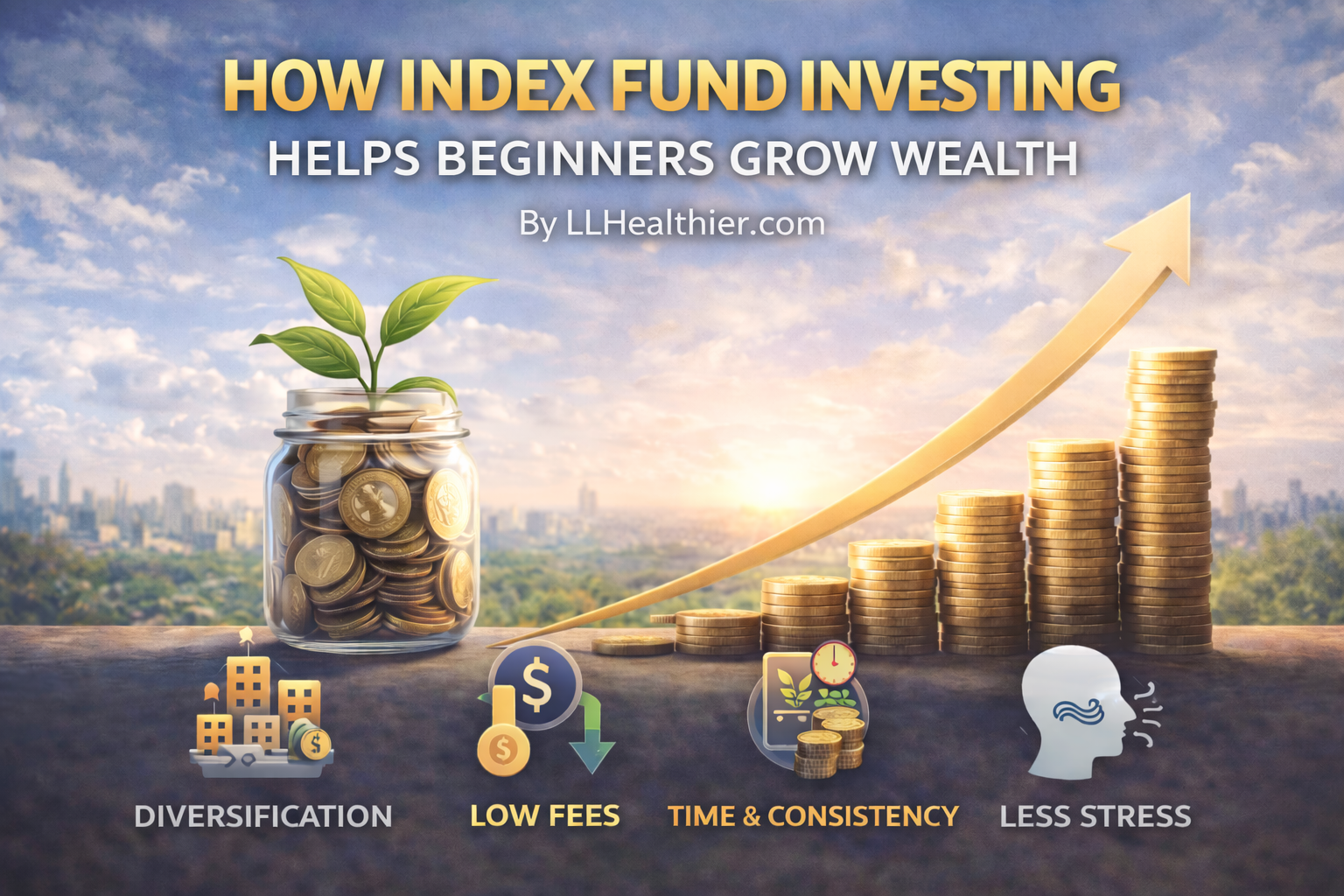
How Index Fund Investing Helps Beginners Grow Wealth
For many Americans, investing feels intimidating at first. The language sounds technical. Financial news moves fast. Stock prices rise and fall by the minute. Social media is full of bold claims, hot tips, and stories about people getting rich overnight. It is no surprise that many beginners freeze before they ever begin.
The truth is that building wealth does not usually require genius predictions, constant trading, or chasing the next exciting stock. In many cases, it comes from something far simpler and far less dramatic. It comes from steady investing, low costs, patience, and time.
That is where index funds have earned their reputation.
Index fund investing has helped millions of ordinary people participate in the growth of the stock market without needing to become market experts. It offers a practical path for beginners who want to grow wealth while keeping things manageable.
If you are new to investing, understanding how index funds work can remove much of the fear and confusion.
What Is an Index Fund?
An index fund is an investment fund designed to track a group of investments known as an index.
An index is simply a collection of stocks or bonds used to measure a market segment. For example, the S&P 500 tracks 500 large U.S. companies. A total stock market index aims to represent a broad slice of the U.S. stock market. International indexes track companies outside the United States. Bond indexes track collections of bonds.
Instead of trying to pick the “best” stocks, an index fund owns many investments in proportions that mirror the chosen index.
That means when you buy one share of an index fund, you are often buying small pieces of many companies at once.
This is one reason index funds are popular. They make diversification easier.
Why Beginners Often Struggle with Individual Stocks
Many new investors start by thinking they need to find winning stocks. It sounds exciting. Buy the right company early, watch it soar, and build wealth quickly.
Sometimes that happens. Often it does not.
Picking individual stocks requires research, judgment, emotional discipline, and a willingness to be wrong. Even professionals with teams of analysts frequently fail to outperform the broader market over long periods.
Beginners also face another challenge. Emotions.
When a stock rises, people may get greedy and buy more at high prices. When it falls, fear can cause panic selling. This buy-high, sell-low pattern hurts many investors.
Index funds help remove much of that pressure. Instead of betting on one or two companies, you participate in the broader market.
Diversification Without Complexity
Diversification means spreading money across many investments rather than concentrating it in one place.
If you put all your savings into one company and that company struggles, your portfolio may suffer badly. If you own hundreds or thousands of companies through index funds, one company has much less power over your results.
This matters because no one knows which company will dominate the future, and no one knows which current giant may stumble.
Index funds accept that uncertainty and build around it.
For beginners, this can be a relief. You do not need to predict tomorrow’s winners. You simply own a wide range of businesses and let time do its work.
Lower Costs Can Make a Big Difference
One of the quiet strengths of index funds is low cost.
Every fund charges fees, often called expense ratios. Higher fees may seem small in a single year, but over decades they can consume a surprising amount of growth.
Index funds usually cost less than actively managed funds because they are not paying teams to constantly pick stocks and trade heavily.
Lower fees mean more of your money stays invested and compounding for you.
This may sound minor compared with flashy market headlines, but controlling costs is one of the few investing factors you can reliably control.
That matters.
Compounding Is Where Wealth Grows
Compounding happens when your investments earn returns, and those returns begin earning returns of their own.
Imagine planting a tree that grows branches, then those branches grow branches. Over time, growth can become meaningful.
This is why starting early helps so much. Even modest monthly contributions can become significant when given enough years.
Many people assume they need a large lump sum to invest. They do not. Time and consistency often matter more than a dramatic starting amount.
A beginner who invests steadily into index funds over twenty or thirty years may build substantial wealth without ever making spectacular moves.
You Do Not Need Perfect Timing
A common mistake among beginners is waiting for the “right” time to invest.
They wait for markets to fall. Then they worry prices may fall further. They wait for clarity. They wait for better headlines. They wait for confidence.
Years can pass this way.
The problem is that no one consistently knows the perfect entry point. Markets move on information quickly and unpredictably.
Many successful long-term investors focus less on perfect timing and more on regular contributions. This approach is often called dollar-cost averaging.
It means investing a set amount regularly, such as monthly, regardless of market mood. Sometimes you buy when prices are higher. Sometimes lower. Over time, consistency can matter more than precision.
For beginners, this removes the burden of trying to outguess the market every month.
Index Funds Reduce Decision Fatigue
Too many choices can stop progress.
There are thousands of stocks, funds, opinions, and forecasts available. A beginner can spend months researching and still feel unsure.
Index funds simplify the process.
Instead of building a complicated portfolio of many individual stocks, many people begin with one or a few broad low-cost index funds.
That simplicity makes it easier to stay consistent. It also reduces the temptation to constantly tinker.
Wealth often grows quietly. Constant changes can interrupt that process.
Emotional Discipline Matters More Than Brilliance
Many people think investing success comes from intelligence alone. In reality, behavior often matters more.
Can you keep investing during scary headlines?
Can you stay patient during boring years?
Can you avoid chasing trends after markets have already surged?
Can you resist selling everything during a downturn?
These are emotional tests more than intellectual ones.
Index fund investing can help because it encourages a long-term mindset. You are not trying to win every week. You are participating in long-run economic growth.
That shift in perspective can be powerful.
What Beginners Commonly Invest In
Many beginners choose broad stock index funds that track the U.S. market, the S&P 500, or a total stock market index. Others add international stock funds for global diversification.
Some include bond index funds, especially as they get older or want smoother portfolio swings.
The right mix depends on age, goals, time horizon, income stability, and comfort with volatility.
A younger investor saving for retirement decades away may accept more stock exposure. Someone nearing retirement may want a more balanced mix.
There is no universal formula. There are only reasonable ranges based on personal circumstances.
Retirement Accounts Can Add Extra Benefits
For many Americans, investing through retirement accounts can improve results.
Accounts such as a 401(k), 403(b), or IRA may offer tax advantages. Some employers also match part of employee contributions in workplace plans.
That match can be highly valuable because it is essentially additional compensation tied to saving.
Many retirement plans offer index fund options, including target-date funds that use diversified index-style building blocks and gradually adjust risk over time.
For beginners, using tax-advantaged accounts can be a smart place to start.
Market Drops Are Normal, Not Failure
One reason beginners quit investing is fear during downturns.
Markets do fall. Sometimes sharply.
This is not a sign that long-term investing is broken. It is part of how markets behave.
Economic slowdowns, recessions, wars, inflation scares, rate changes, and uncertainty can all create declines. Yet over long periods, markets have historically recovered and moved higher, though past performance never guarantees future results.
The key lesson is this: volatility is the price investors often pay for long-term growth potential.
If every decline causes panic selling, it becomes hard to capture recoveries.
Index fund investors who stay disciplined often benefit from patience during these periods.
The Danger of Chasing Hot Trends
Every era has its craze.
Sometimes it is tech stocks. Sometimes crypto. Sometimes meme stocks. Sometimes speculative sectors with dramatic stories.
Some people make money in these waves. Many arrive late, buy high, and suffer losses when enthusiasm fades.
Beginners are especially vulnerable because excitement can feel like proof.
Index fund investing may seem boring compared with hot trends, but boring is not a flaw in finance. Often it is a strength.
Steady progress beats emotional roller coasters for many households.
How Much Should a Beginner Invest?
The best amount is the amount you can invest consistently while still handling real life responsibly.
That means covering necessities, building an emergency fund, managing high-interest debt thoughtfully, and investing within your means.
For some people, that may start at $50 or $100 a month. For others, it may be much more.
The size of the first step matters less than making the first step habitual.
As income grows, contributions can grow too.
Raises, bonuses, side income, and paid-off debts often create room to invest more later.
Mistakes to Avoid
One common mistake is waiting until you feel like an expert. Most people learn by starting small and staying engaged.
Another mistake is checking balances obsessively. Daily market movement can create unnecessary stress and poor decisions.
Some beginners jump from strategy to strategy every few months. They start with index funds, then switch to stock picking, then options, then back again.
Frequent strategy changes often reflect discomfort, not wisdom.
Another mistake is ignoring fees and taxes. What you keep matters more than flashy returns on paper.
A Simple Example of How Wealth Can Build
Imagine someone invests a modest amount every month into a broad index fund for many years. They continue during bull markets, bear markets, elections, recessions, and noisy headlines.
At first, progress feels slow.
Then the account grows enough that annual gains begin to matter. Later, compounding becomes more visible. What once felt small begins to feel substantial.
This is how wealth often happens. Quietly, gradually, then noticeably.
Why Simplicity Wins for Many People
Complexity can feel sophisticated, but it is not always useful.
Many strong financial plans are built on simple foundations: spend less than you earn, avoid destructive debt, maintain emergency savings, invest consistently, keep costs low, stay diversified, and be patient.
Index funds fit naturally into that framework.
They allow ordinary people to own productive businesses across the economy without needing to become full-time investors.
That accessibility is one reason they changed personal finance for so many families.
Index fund investing helps beginners grow wealth by making investing simpler, broader, lower-cost, and easier to sustain over time.
You do not need to predict winning stocks. You do not need to trade constantly. You do not need to time the market perfectly.
You need a sensible plan, regular contributions, patience, and discipline.
For the average American trying to build a stronger future, that can be enough.
Sometimes the smartest financial move is not the most exciting one. It is the one you can stick with for decades.
Found this article interesting? Bookmark it to read again later.
Then, share it for others to read. 🌎
Thank you!










Post Comment