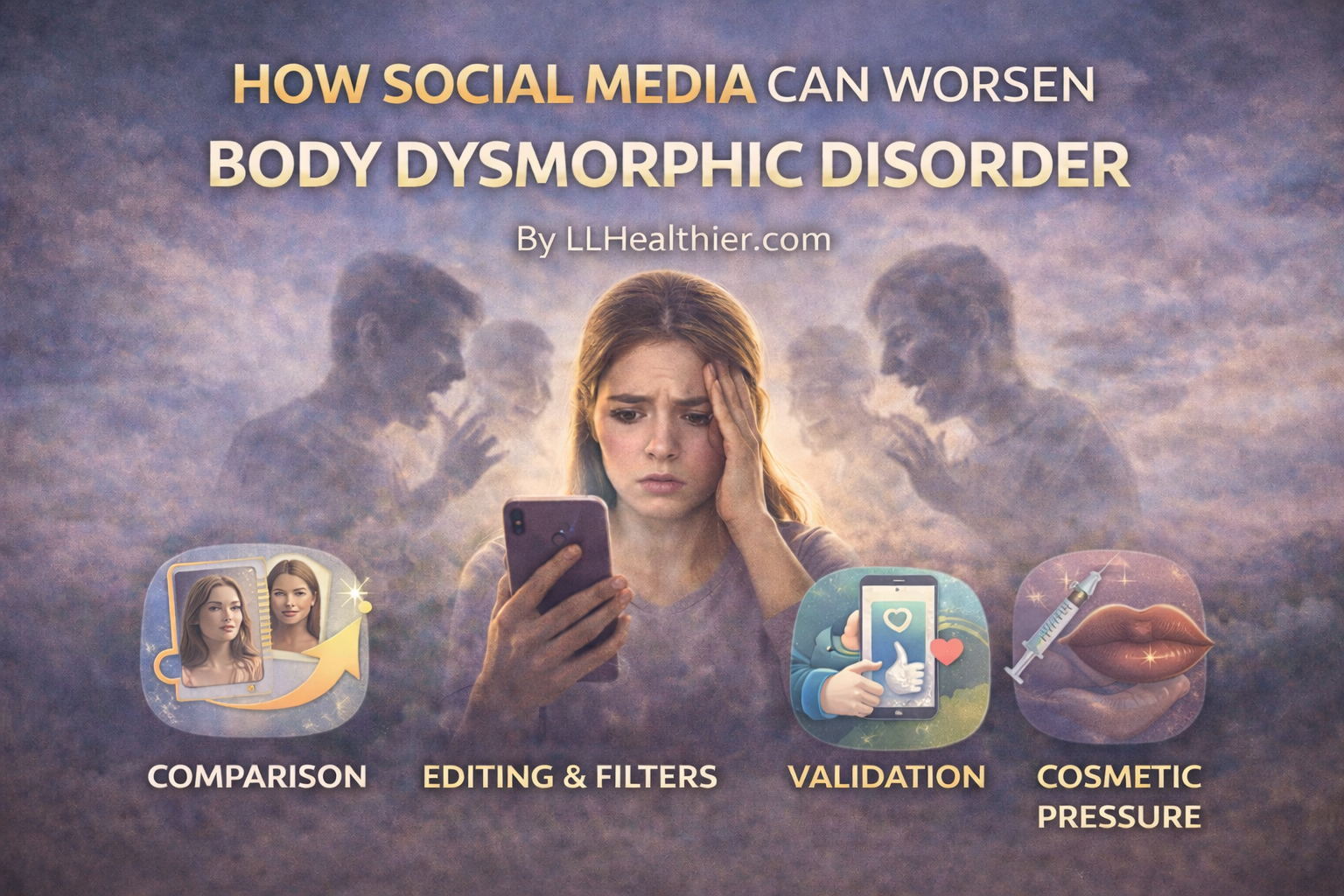
How Social Media Can Worsen Body Dysmorphic Disorder
Social media has changed the way people see themselves. With a few taps, anyone can compare their face, body, skin, hair, style, and lifestyle to hundreds of others in a single sitting. Photos are polished. Angles are selected carefully. Filters smooth skin, sharpen features, brighten eyes, and erase signs of normal human life.
For many people, this creates occasional insecurity. For someone living with body dysmorphic disorder, it can become far more serious.
Body dysmorphic disorder, often called BDD, is a mental health condition in which a person becomes intensely preoccupied with perceived flaws in their appearance. These flaws may be minor or not noticeable to others at all, yet they feel deeply real and distressing to the person experiencing them.
Social media does not cause every case of BDD, but it can worsen symptoms, reinforce unhealthy thinking patterns, and keep people trapped in painful cycles of comparison and self-criticism.
Understanding that connection matters, especially in a culture where screen time is common and appearance is often treated like public currency.
What Body Dysmorphic Disorder Really Is
Many people casually say they are “obsessed” with a feature they dislike, but BDD is more than ordinary insecurity.
A person with body dysmorphic disorder may spend hours each day thinking about perceived defects. They may repeatedly check mirrors, avoid mirrors, seek reassurance, compare themselves to others, camouflage the area with makeup or clothing, pick at skin, or avoid social situations entirely.
Some become convinced their nose is deformed, their skin is ruined, their jaw is wrong, their body is unacceptable, or their hair is hopeless, even when others do not see the issue in the same way.
The distress can be severe. BDD can interfere with work, relationships, school, dating, and daily functioning. Depression, anxiety, and suicidal thoughts may also occur.
This is a real mental health condition, not vanity.
Why Social Media Can Be a Problem
Social media platforms are built around images, reactions, and attention. That environment can be challenging for anyone, but especially for people vulnerable to appearance-based anxiety.
Many platforms reward visual perfection. Attractive images receive likes, comments, follows, and algorithmic visibility. Users learn quickly what gets attention.
As a result, feeds can become filled with edited photos, idealized bodies, cosmetic procedures, beauty tips, gym transformations, skin routines, and before-and-after content.
For someone with BDD, this can feel like entering a room where every mirror talks back.
The Comparison Trap
Human beings naturally compare themselves to others. Social media turns that tendency into a nonstop activity.
Instead of comparing yourself to a few classmates or coworkers, you may compare yourself to influencers, models, fitness personalities, celebrities, or strangers posting their best moments under flattering lighting.
For a person with BDD, comparison often confirms distorted beliefs.
They may think, “Everyone else has clear skin.” “Everyone else has the right jawline.” “Everyone else looks normal except me.”
These thoughts are painful, and they are often inaccurate. What they are seeing is not ordinary reality. It is selected reality.
Still, repeated exposure can make unrealistic standards feel normal.
Filters and Face Editing Tools
One of the most troubling changes in recent years is the widespread use of filters and editing apps.
Skin can be smoothed instantly. Eyes can be enlarged. Noses narrowed. Lips enhanced. Jawlines sharpened. Bodies reshaped. Lighting improved. Texture removed.
Many users know this happens intellectually. Emotionally, it can still affect them.
A person with BDD may begin judging their real face against a digitally altered standard. They may dislike photos that are not filtered. They may feel distress when seeing themselves in mirrors or candid pictures because reality no longer matches the edited image.
Some clinicians have referred to a rise in patients seeking cosmetic changes to look like filtered versions of themselves.
That is a troubling sign of how powerful these tools can be.
Reassurance Seeking Through Likes and Comments
People with BDD often seek reassurance. They may ask others if they look okay, whether a flaw is visible, or if something seems wrong.
Social media can become a new form of reassurance seeking.
Someone may post selfies repeatedly, monitor reactions, delete photos that do not receive enough engagement, or feel temporary relief when compliments arrive.
But reassurance usually fades quickly.
Soon the person may need another post, another flattering angle, another comment section, another sign that they are acceptable.
This creates dependence on outside approval rather than internal stability.
Mirror Checking in Digital Form
Classic BDD behaviors can include mirror checking or avoiding mirrors altogether. Social media can turn the phone into a portable mirror.
Front-facing cameras allow endless checking. A person may repeatedly inspect facial symmetry, skin texture, body shape, or angles throughout the day.
They may take dozens of photos and delete nearly all of them. They may zoom in on details no one else would notice.
What feels like problem-solving often deepens the obsession.
The more attention given to perceived flaws, the larger those flaws can feel.
Cosmetic Procedure Pressure
Social media is full of content promoting fillers, Botox, skin treatments, jawline contouring, cosmetic surgery, and body sculpting.
Some of this content is educational. Much of it is marketing.
For a person with BDD, these messages can intensify the belief that appearance problems must be fixed immediately.
They may chase one procedure after another, believing the next change will finally bring peace. Unfortunately, when the underlying issue is BDD, satisfaction is often short-lived or absent.
The distress usually lives in perception and obsession, not in the body part itself.
That is why psychological treatment is so important.
The Algorithm Effect
Many people do not realize how quickly platforms learn their insecurities.
If someone watches videos about acne, noses, jawlines, weight loss, or cosmetic procedures, the platform often serves more of the same.
Soon the feed may become saturated with appearance-focused content.
This creates the illusion that everyone is talking about flaws, fixing flaws, and being judged for flaws.
In reality, the algorithm is reflecting back what captured attention.
For someone with BDD, this can feel like evidence that appearance concerns are urgent and universal.
Adolescents and Young Adults Are Especially Vulnerable
Teenagers and young adults are still forming identity, confidence, and self-image. They are also highly sensitive to peer feedback.
This makes social media particularly potent during those years.
A teen struggling with body image may become consumed by comparing themselves to edited peers or influencers. A young adult may tie self-worth to photos, likes, or dating app appearance standards.
When BDD begins in adolescence, early intervention matters. The condition can become more entrenched if ignored.
Parents and caregivers should take severe appearance distress seriously rather than dismissing it as “just a phase.”
Signs Social Media May Be Worsening BDD
Sometimes the pattern becomes clear only when stepping back.
A person may feel anxious after scrolling. Mood drops after seeing others’ photos. They spend excessive time editing selfies. They cancel plans because they dislike how they look. They obsess over comments or lack of engagement. They repeatedly search appearance advice or cosmetic fixes.
They may know the behavior hurts them but feel unable to stop.
That combination of distress and compulsion is important to notice.
What Actually Helps
When social media worsens BDD, the answer is usually not shame or simply telling someone to “stop caring what people think.”
BDD is a mental health condition that responds best to proper treatment.
Cognitive behavioral therapy, especially therapy tailored to BDD, is often highly effective. It helps people challenge distorted beliefs, reduce compulsive checking behaviors, tolerate discomfort, and rebuild healthier thinking patterns.
Some people also benefit from medication, particularly selective serotonin reuptake inhibitors prescribed by a qualified clinician.
Treatment can be life-changing.
Creating Healthier Social Media Habits
While treatment addresses the deeper issue, digital habits matter too.
Curating the feed can help. Unfollowing accounts that trigger obsession or comparison may reduce daily stress. Following creators who promote realism, mental health, creativity, humor, education, or values beyond appearance can shift the environment.
Limiting time on image-heavy platforms may also help. Many people notice mood improves when scrolling decreases.
Removing beauty filters from regular use can be powerful. It helps reconnect the brain with normal human faces, including your own.
Taking breaks from posting may reduce the cycle of external validation.
Small changes can create breathing room.
The Importance of Self-Compassion
People with BDD are often harsh toward themselves in ways they would never be toward others.
They may speak internally with cruelty, disgust, or relentless criticism.
Recovery includes learning a different voice.
Self-compassion does not mean pretending every insecurity vanishes. It means relating to pain with patience rather than punishment.
You are not a project that must be perfected before you deserve peace.
That shift can take time, but it matters deeply.
What Friends and Family Can Do
Loved ones often want to reassure constantly, argue about appearance, or say “you look fine” repeatedly.
While well-meaning, endless reassurance can unintentionally feed the cycle.
A better approach is empathy paired with encouragement toward treatment.
You might say, “I can see this is causing real distress,” or “I know this feels very real to you,” followed by support for counseling or professional help.
Avoid mocking concerns or labeling the person vain. BDD is painful, not superficial.
Patience helps.
You Are More Than an Image
One of the hidden harms of social media is that it can shrink identity down to appearance.
But a person is not just a face, a body, a nose, a skin texture, or a photo.
You are also humor, kindness, resilience, values, intelligence, creativity, loyalty, faith, curiosity, skill, and love.
BDD narrows attention until all of that disappears behind one perceived flaw.
Recovery widens the lens again.
When to Seek Professional Help
If appearance worries consume hours of the day, interfere with relationships or work, lead to isolation, cause depression, involve repetitive checking behaviors, or trigger hopelessness, professional support is important.
If suicidal thoughts are present, seek urgent help immediately.
BDD is treatable, and earlier care often leads to better outcomes.
No one needs to wait until things become unbearable.
Social media can worsen body dysmorphic disorder by fueling comparison, promoting edited beauty standards, encouraging reassurance seeking, and amplifying obsessive focus on appearance.
For someone with BDD, the problem is not weakness or vanity. It is a real mental health condition interacting with a powerful digital environment.
The good news is that healing is possible. With therapy, healthier online habits, support, and compassion, people can loosen the grip of appearance obsession and reconnect with a fuller life.
You were never meant to measure your worth against a filtered screen.
Found this article interesting? Bookmark it to read again later.
Then, share it for others to read. 🌎
Thank you!










Post Comment