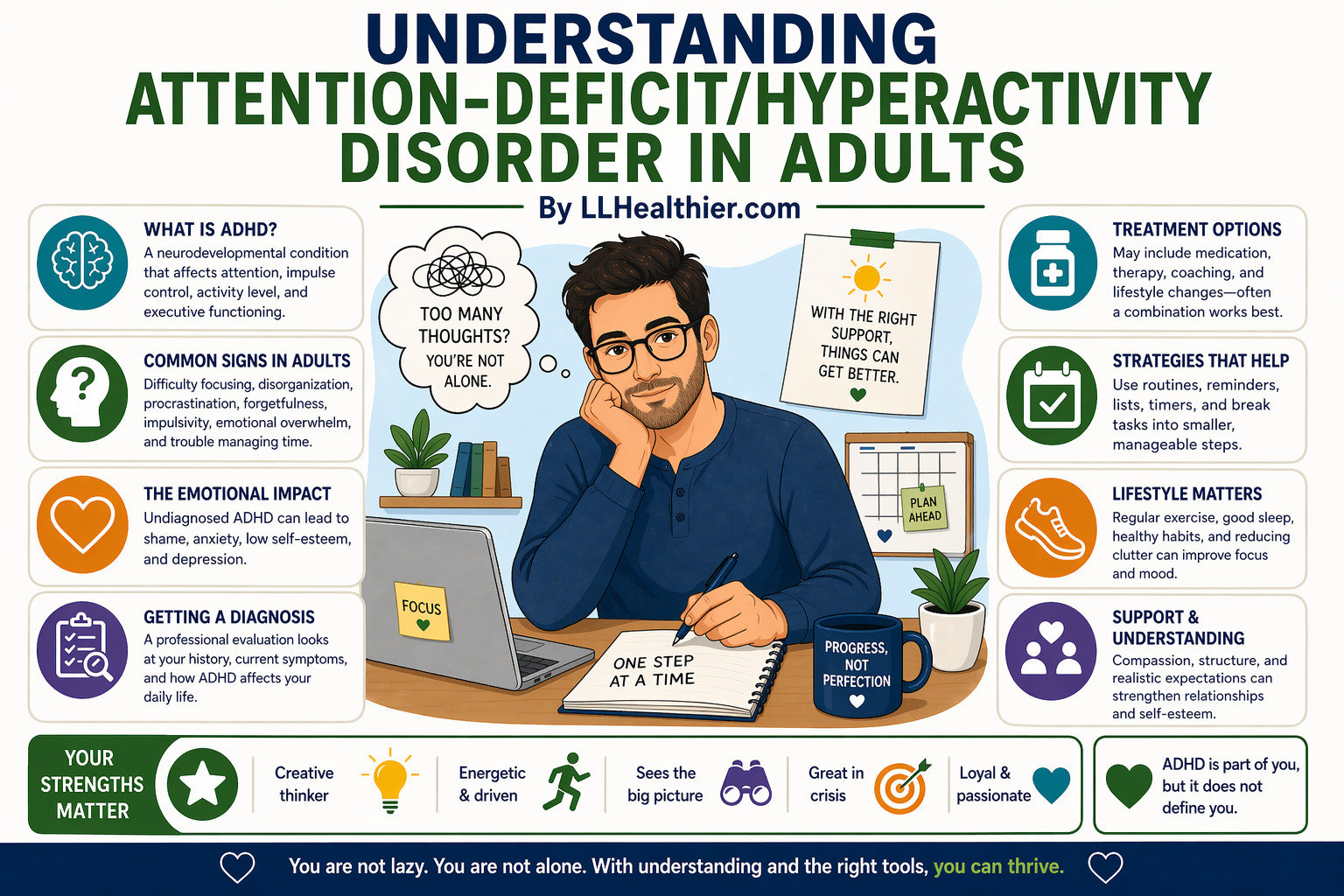
Understanding Attention-Deficit/Hyperactivity Disorder in Adults
Many people think of Attention-Deficit/Hyperactivity Disorder, often called ADHD, as a childhood condition. They picture a restless student who struggles to sit still in class, blurts out answers, or has trouble finishing homework. While ADHD is often identified in childhood, it does not always disappear with age. For many people, it continues into adulthood, sometimes in ways that look different than expected.
Adult ADHD is frequently misunderstood. Some adults have lived with symptoms for years without realizing there is a name for what they experience. Others were diagnosed as children but never fully understood how ADHD might continue affecting work, relationships, finances, organization, and emotional well-being later in life.
This can be frustrating. Many adults quietly blame themselves for struggles that may have a neurological basis rather than a character flaw. They may believe they are lazy, careless, immature, scattered, or incapable of discipline.
The truth is more nuanced and more hopeful. ADHD is a treatable condition, and with the right support, many adults learn how to work with their brain rather than against it.
What Is ADHD
ADHD is a neurodevelopmental condition that affects attention regulation, impulse control, activity level, planning, and executive functioning. Executive functions are the mental skills that help people organize, prioritize, begin tasks, manage time, regulate emotions, and follow through.
ADHD does not mean a person lacks intelligence or motivation. Many adults with ADHD are bright, creative, hardworking, and deeply capable. The challenge is often not knowing what to do, but consistently doing it in an organized and timely way.
The name ADHD can also be misleading. Many adults can focus intensely on activities that are stimulating or urgent. The issue is often inconsistent attention regulation rather than a total lack of attention.
That distinction matters because many people misunderstand their own symptoms.
How ADHD Can Look Different in Adults
Adult ADHD does not always look like childhood hyperactivity. Some adults are physically restless, but others mainly experience internal restlessness. Their mind may feel busy, scattered, or constantly moving.
Instead of running around a classroom, an adult may interrupt conversations, overcommit, lose track of time, forget appointments, procrastinate, misplace items, or struggle to manage competing responsibilities. They may start projects enthusiastically and then lose momentum halfway through.
Some adults appear successful from the outside while privately using enormous effort to stay afloat. They may rely on last-minute pressure, chronic stress, or long hours to compensate for organizational difficulties.
Because of this, ADHD is often missed.
Common Signs of Adult ADHD
Many adults with ADHD describe difficulty sustaining attention during boring or repetitive tasks. They may zone out in meetings, skim information without retaining it, or avoid paperwork until it becomes urgent.
Time management problems are also common. A person may underestimate how long tasks take, run late often, or delay starting until deadlines create panic.
Disorganization can show up in cluttered spaces, unfinished chores, chaotic email inboxes, unpaid bills, or difficulty creating routines.
Impulsivity may appear as interrupting others, overspending, blurting comments, changing plans suddenly, or making quick decisions without fully thinking them through.
Emotional frustration can also be part of the picture. Many adults with ADHD feel overwhelmed more easily and become discouraged after repeated struggles.
The Emotional Cost of Undiagnosed ADHD
When ADHD goes unrecognized, people often create painful explanations for their difficulties.
They may think, “Everyone else can handle life, so what is wrong with me?” They may feel ashamed about missed deadlines, forgotten birthdays, unfinished goals, or financial disorganization. Over time, self-esteem can suffer.
Many adults with untreated ADHD develop anxiety because they are constantly trying to keep up. Others develop depression after years of feeling they are failing despite sincere effort.
This emotional burden can sometimes be more painful than the core ADHD symptoms themselves.
ADHD Is Not Laziness
This point deserves emphasis.
Laziness suggests unwillingness to act. ADHD more often involves difficulty activating, organizing, and sustaining action even when the person deeply cares about the outcome.
An adult with ADHD may want a clean home, stable finances, timely paperwork, and consistent routines. They may care intensely. Yet they struggle to translate intention into steady execution.
This mismatch between desire and performance can be confusing for both the person and their loved ones.
Understanding the difference can reduce blame and open the door to solutions.
Why Some Adults Are Diagnosed Later in Life
Many adults were never diagnosed as children because symptoms were missed, misunderstood, or masked.
Some were bright students who compensated academically until life became more complex. Others had quieter inattentive symptoms rather than disruptive behavior, so they attracted less attention from teachers or parents.
Women in particular have historically been underdiagnosed because ADHD does not always match old stereotypes. Many women were labeled daydreamy, emotional, disorganized, or anxious rather than properly evaluated.
Life transitions often bring symptoms into sharper focus. College, parenthood, demanding careers, remote work, or caring for multiple responsibilities can overwhelm coping systems that once barely worked.
How ADHD Affects Relationships
ADHD can influence relationships in subtle but meaningful ways.
A partner may feel hurt when birthdays are forgotten, chores are inconsistent, or listening appears distracted. The adult with ADHD may feel criticized, misunderstood, or ashamed.
Impulsivity can lead to speaking before thinking. Difficulty shifting attention may make transitions hard. Emotional reactivity may intensify arguments.
These patterns can improve significantly when ADHD is recognized and managed. What once looked like indifference may actually be a treatable attention and regulation issue.
Understanding changes the conversation.
How ADHD Affects Work and Career
Many adults with ADHD are talented and hardworking, yet work life can be stressful.
They may thrive in fast-paced, creative, stimulating environments but struggle with repetitive administrative tasks. Some excel in crisis mode because urgency boosts focus. Others have trouble prioritizing when many tasks compete at once.
Missed deadlines, disorganization, inconsistent follow-through, or difficulty with paperwork can limit advancement despite strong potential.
The right systems, accommodations, and treatment often improve career functioning substantially.
Hyperfocus: The Lesser-Known Side
Many people are surprised to learn that ADHD can involve periods of intense focus.
When a task is interesting, urgent, novel, or emotionally engaging, some adults can focus for hours and lose track of time. This is sometimes called hyperfocus.
While it can be productive, it may also create imbalance. A person may ignore meals, forget appointments, or neglect other responsibilities while absorbed in one activity.
This is another example of ADHD involving regulation of attention, not simply absence of it.
Getting an Accurate Evaluation
If ADHD seems possible, a professional evaluation is important.
ADHD symptoms can overlap with anxiety, depression, trauma, sleep disorders, substance use, thyroid issues, and other medical or psychological conditions. Stress alone can also impair focus and organization.
A proper assessment often includes clinical history, current symptoms, childhood patterns, functional impact, and screening for other conditions.
Self-diagnosis through short online checklists may be a starting point for curiosity, but not a substitute for comprehensive evaluation.
Treatment Can Be Highly Effective
Many adults are relieved to learn that ADHD is treatable.
Treatment may include medication, therapy, coaching, lifestyle changes, or a combination depending on the person’s needs. Medication can help some people improve attention, reduce impulsivity, and increase follow-through.
Therapy can help address shame, anxiety, relationship stress, emotional regulation, and practical coping strategies. Coaching may focus on systems for planning, routines, accountability, and task management.
There is no one perfect path. Effective treatment is individualized.
Daily Strategies That Help
Adults with ADHD often benefit from external structure.
Calendars, reminders, visual cues, written lists, timers, routines, and simplified systems can reduce mental load. Breaking tasks into smaller steps often helps overcome paralysis.
Many people do better when tasks are started before motivation appears. Waiting to “feel ready” can lead to chronic delay.
Body movement, adequate sleep, and reducing clutter can also improve functioning.
Simple tools are not childish. They are intelligent supports.
Emotional Healing Matters Too
Some adults focus only on productivity after diagnosis, but emotional healing is just as important.
Years of criticism, self-doubt, and comparison can leave scars. A person may carry the identity of being careless, lazy, or disappointing long after learning they have ADHD.
Part of treatment is updating that story.
You may have struggled, but struggle is not the same as failure. Many people were trying hard with tools that did not fit how their brain works.
That realization can be deeply freeing.
ADHD and Strengths
ADHD brings challenges, but many adults also possess meaningful strengths.
Some are highly creative, intuitive, energetic, humorous, resilient, entrepreneurial, or able to think quickly under pressure. Many notice patterns others miss. Some bring warmth, spontaneity, and bold ideas to teams and families.
Strengths do not erase difficulties, and difficulties do not erase strengths.
Both can be true at the same time.
Supporting a Loved One with ADHD
If someone you love has ADHD, curiosity helps more than criticism.
Try to distinguish symptoms from intent. Forgetfulness may not mean lack of care. Delays may not mean disrespect. Emotional overwhelm may not mean manipulation.
At the same time, understanding should include accountability. ADHD explains patterns, but it does not excuse harmful behavior indefinitely.
Healthy support combines compassion with practical systems.
When to Seek Help
Consider professional evaluation if chronic attention, impulsivity, disorganization, procrastination, emotional overwhelm, or inconsistent functioning are significantly affecting work, relationships, finances, or self-esteem.
Many adults wait until burnout forces action.
Earlier support can prevent years of unnecessary suffering.
You do not need to hit rock bottom to deserve help.
ADHD in adults is real, common, and often misunderstood. It affects attention regulation, planning, organization, emotional control, and follow-through, not intelligence or worth.
Many adults have spent years blaming themselves for struggles that can improve with proper understanding and treatment.
If this topic feels familiar, consider seeking a qualified evaluation. The goal is not to label yourself unfairly. It is to understand your mind more accurately.
Sometimes the turning point in life begins when self-judgment is replaced by clarity, strategy, and support.
Found this article interesting? Bookmark it to read again later.
Then, share it for others to read. 🌎
Thank you!










Post Comment