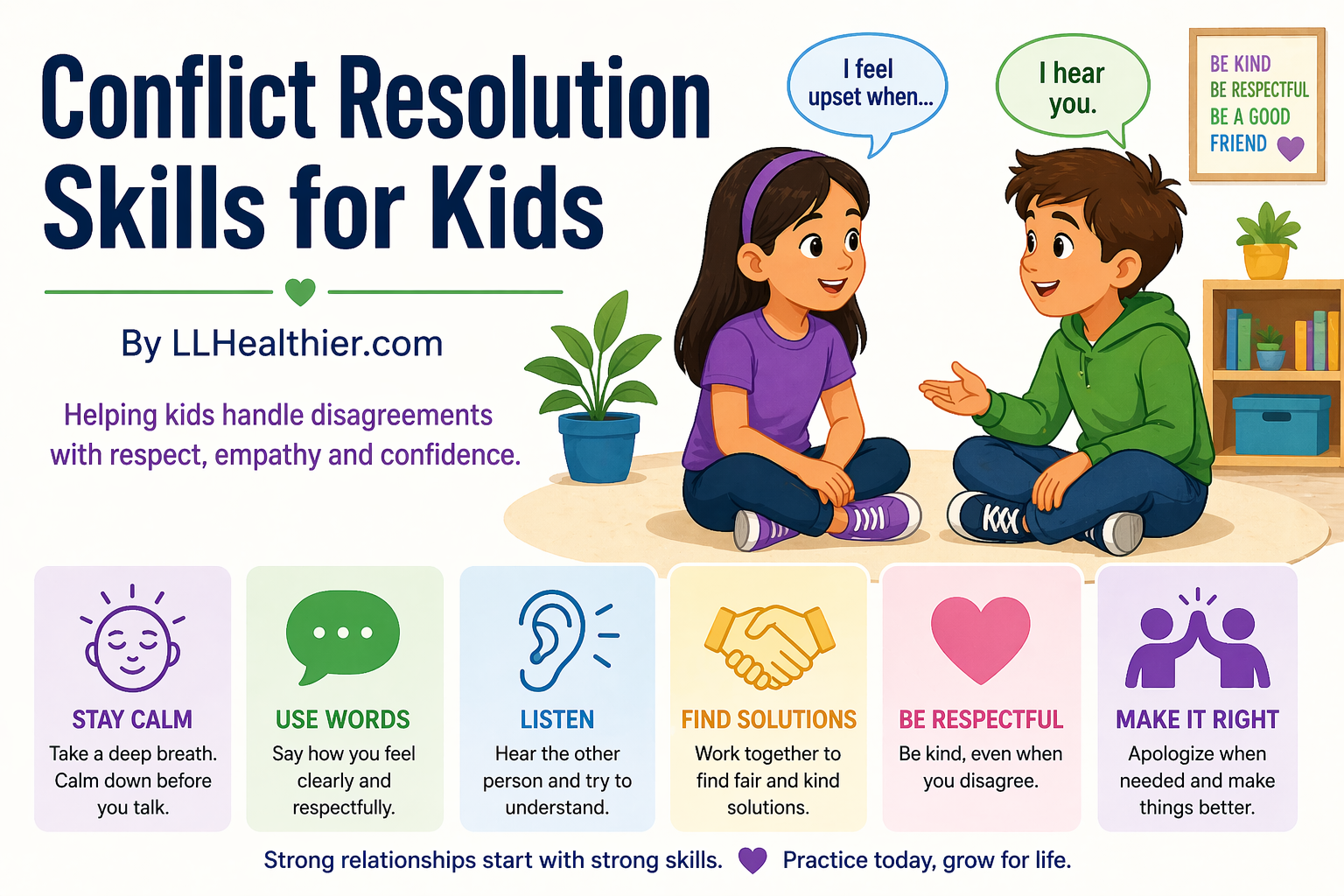
Conflict Resolution Skills for Kids
Conflict is a normal part of childhood. Children argue over toys, games, turns, fairness, rules, space, attention, and misunderstandings. Siblings clash. Friends get upset. Classmates disagree. These moments can be frustrating for both kids and adults, but conflict itself is not the real problem.
The real issue is whether children learn healthy ways to handle it.
When kids develop conflict resolution skills, they gain tools that help far beyond childhood. They learn how to communicate, calm themselves, understand others, solve problems, and repair relationships. These skills support success at home, in school, in friendships, and later in adult life.
The good news is that children are highly teachable. Most conflict skills can be learned with guidance, repetition, and patient modeling.
Why Conflict Can Be Hard for Kids
Children are still developing emotional regulation, impulse control, empathy, and communication. Many kids feel strong emotions before they have words to explain them. They may know they are upset but not know whether they feel embarrassed, disappointed, jealous, left out, or frustrated.
Because of this, children often express conflict physically or loudly before they can express it clearly.
They may yell, grab, cry, stomp away, blame quickly, or shut down.
This is not proof that a child is bad. It is often proof that a child needs coaching.
Teach That Conflict Is Normal
Some children think disagreement means friendship is over or that someone is mean forever. Others feel ashamed anytime tension happens.
It helps to teach kids that conflict is a normal part of relationships. Even good friends disagree. Loving siblings argue. Classmates misunderstand each other.
What matters most is how people handle the disagreement.
This message reduces panic and helps children stay solution-focused.
Start with Calming Down First
A child who is flooded with emotion usually cannot solve a problem well. When kids are angry or overwhelmed, the thinking part of the brain is less available. In that moment, lectures often fail. Problem-solving usually goes better after calming down.
Teach children simple ways to reset such as slow breathing, counting, squeezing a pillow, taking space for a minute, or getting a drink of water.
Calm first, solve second.
Help Kids Name Feelings
Children often say “It’s not fair” when the deeper feeling is hurt, embarrassment, jealousy, disappointment, or loneliness.
Helping kids identify emotions gives them language stronger than yelling or hitting. You might say, “You seem frustrated because your turn ended,” or “It sounds like you felt left out.” Over time, children learn to say what they feel more directly.
Words can replace many power struggles.
Teach the Difference Between Feelings and Behavior
All feelings are allowed. Not all behaviors are.
A child can feel angry, jealous, disappointed, or annoyed without being shamed for the emotion. But hitting, insulting, destroying property, or threatening others still needs limits.
This distinction is powerful.
When children learn that feelings are acceptable but behavior must be guided, they become less afraid of emotion and more responsible with actions.
Encourage Listening
Many children focus only on being heard. They want adults or peers to understand their side immediately.
Listening is just as important.
Teach children to pause and hear what the other person is saying. This does not mean they must agree. It means understanding another perspective before reacting.
A child who can say, “I hear that you thought I cut in line,” is learning a mature skill.
Use Clear, Simple Communication
Children benefit from learning straightforward statements instead of blame.
Instead of yelling “You’re mean,” they can learn to say, “I didn’t like that,” or “Please stop,” or “I was using that.”
These phrases may seem basic, but they reduce confusion and aggression.
Simple communication gives children a sense of power without needing cruelty.
Teach Taking Turns and Compromise
Many childhood conflicts involve fairness and access.
Two children want the same toy. Both want the front seat. Both want to choose the game. These moments are ideal chances to teach flexibility.
Children can learn that sometimes they get their first choice, and sometimes they do not. They can also learn creative solutions such as timers, alternating turns, combining ideas, or choosing something new.
Compromise is one of the building blocks of peaceful living.
Model Healthy Conflict at Home
Children learn more from what adults do than what adults say. If kids constantly watch screaming, insults, sarcasm, stonewalling, or explosive reactions, those patterns can become normalized. If they watch respectful disagreement, repair, apology, and calm communication, they absorb those patterns too.
No parent is perfect.
But children benefit greatly when adults try to model emotional responsibility.
Teach Apologies That Matter
Many children are forced to say sorry before they understand what happened. A rushed apology may stop noise, but it does not always teach empathy. Better apologies help children connect behavior with impact.
Encourage statements such as, “I’m sorry I grabbed your toy. That was rude,” or “I’m sorry I hurt your feelings.”
A real apology includes understanding, not only words.
Teach Repair After Mistakes
Conflict skills are not only about avoiding mistakes. They are also about repairing them.
Children will say hurtful things, exclude someone, overreact, lie, or act selfishly at times. This is part of growth. What matters is learning how to make things better afterward.
Repair may include apologizing, replacing something broken, inviting someone back in, or doing better next time. This teaches accountability without hopelessness.
Help Kids Handle Friendship Problems
Friendship conflict can feel enormous to children. Being left out at recess or hearing that someone said something mean may feel like the end of the world in that moment. Adults should not mock or minimize this pain.
Instead, help children slow down, gather facts, express feelings, and choose a wise response. Sometimes the answer is a conversation. Sometimes it is space. Sometimes it is choosing healthier friends.
Childhood friendships are practice for later relationships.
Teach Boundaries Too
Conflict resolution does not mean always keeping the peace.
Children also need to know they can say no, walk away, ask an adult for help, or protect themselves from repeated mistreatment. If another child is aggressive, manipulative, or unsafe, the goal is not endless compromise.
Healthy conflict skills include boundaries.
Kindness and self-respect belong together.
Praise Progress, Not Perfection
Children improve through repetition.
Notice when they calm themselves faster, use words instead of yelling, listen better, or solve a dispute with less help. These moments deserve attention.
Growth often happens gradually.
A child who still argues but now recovers in five minutes instead of fifty is making real progress.
When Adults Should Step In
Not every conflict should be left to children alone. Adults should intervene when there is physical aggression, bullying, threats, unsafe behavior, large age imbalances, repeated targeting, or emotional overwhelm beyond the child’s ability.
Supportive intervention teaches safety and structure.
The goal is not rescuing kids from every discomfort. It is guiding them through what they cannot yet manage alone.
Practice Through Everyday Moments
Conflict skills are built in ordinary life.
Siblings arguing over the remote, kids disagreeing about game rules, a child upset over sharing markers, or frustration during homework all create learning opportunities.
You do not need a formal lecture each time. Short coaching moments repeated often can shape lifelong habits.
What to Say to a Child in Conflict
Simple language helps.
You might say, “Take a breath and use your words.” Or, “Tell me what happened without blaming.” Or, “What do you think they felt?” Or, “How can we fix this?”
These phrases guide thinking rather than only punishing behavior.
Children need tools more than shame.
Conflict resolution skills for kids help children become calmer, kinder, stronger, and more capable in relationships. They learn to regulate emotions, communicate clearly, listen, compromise, repair mistakes, and set boundaries when needed.
Conflict is not a sign that childhood is going wrong. It is often the classroom where emotional intelligence is built.
With patient coaching and steady modeling, children can learn skills that serve them for the rest of their lives.
Found this article interesting? Bookmark it to read again later.
Then, share it for others to read. 🌎
Thank you!







Post Comment