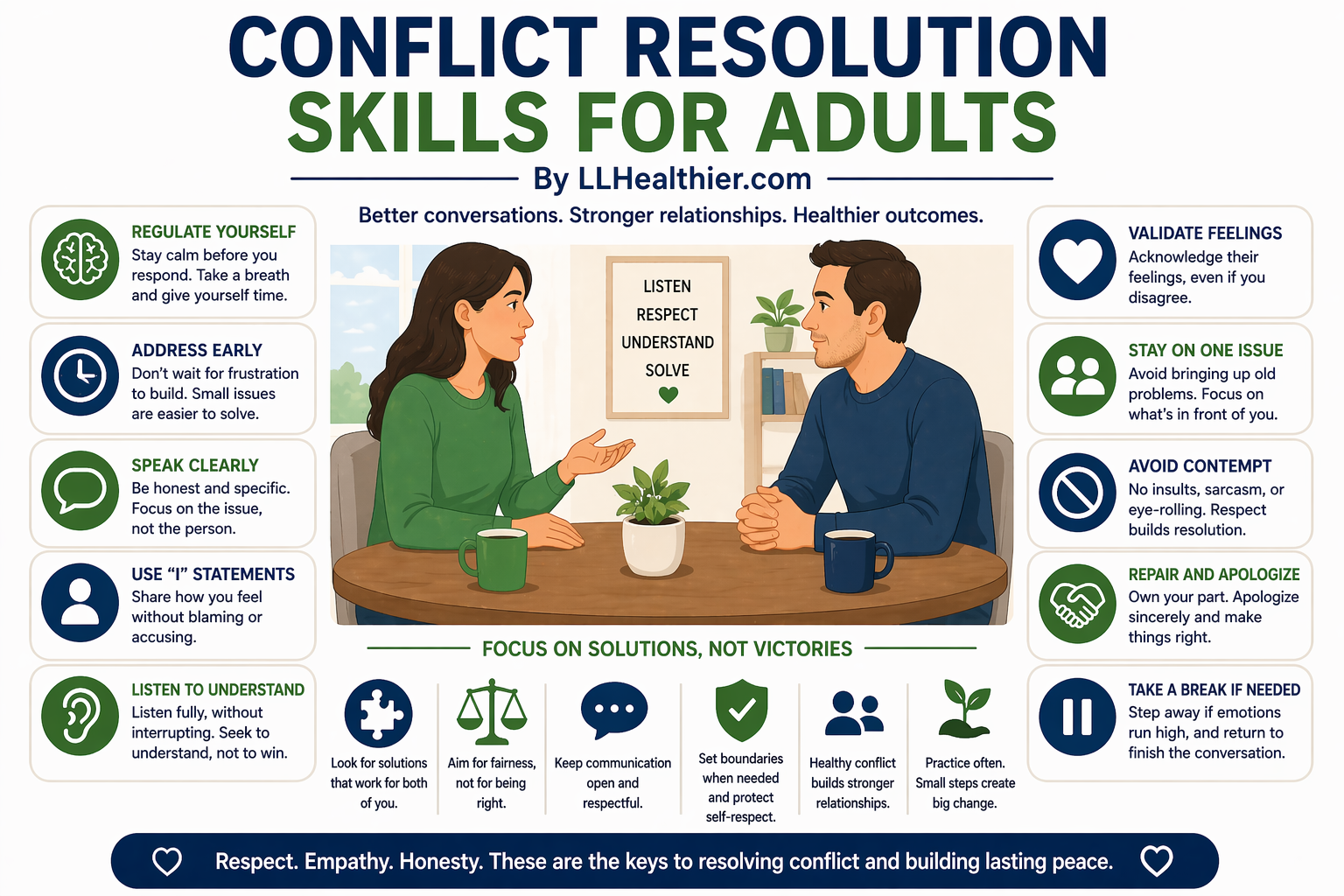
Conflict Resolution Skills for Adults
Conflict is part of adult life. It shows up in marriages, friendships, families, workplaces, neighborhoods, and everyday interactions. Two people can care about each other deeply and still disagree. In fact, disagreement is normal whenever different personalities, values, stress levels, and expectations meet.
Many adults were never truly taught how to handle conflict well. They may have grown up around yelling, silent treatment, sarcasm, avoidance, or emotional shutdown. Others learned to keep the peace at any cost, even when resentment quietly built underneath.
The good news is that conflict resolution is a skill set, not a personality trait. You do not need to be naturally calm, endlessly patient, or highly extroverted to improve. With practice, most adults can learn to handle disagreements with more maturity, clarity, and self-respect.
Healthy conflict resolution does not mean getting your way every time. It means addressing problems in a way that protects dignity, relationships, and long-term peace.
Understand What Conflict Really Is
Many people hear the word conflict and imagine fighting. They picture shouting matches, slammed doors, harsh texts, or dramatic endings. But conflict simply means a tension between needs, views, expectations, or boundaries.
A conflict may be about money, chores, parenting, communication, loyalty, time, trust, work responsibilities, or respect. Sometimes the surface issue is small, while the real issue underneath is feeling unseen, dismissed, overwhelmed, or hurt.
Understanding this matters because many arguments are not really about the dishes, the late arrival, or the missed call. They are about what those moments symbolize emotionally.
When you learn to look beneath the surface, resolution becomes more possible.
Regulate Yourself Before You Respond
One of the most valuable conflict skills is emotional regulation.
When people feel attacked, ignored, embarrassed, or triggered, the body can move into stress mode quickly. Heart rate rises, muscles tense, and thinking narrows. In that state, people often say things they regret or hear only part of what is being said.
Before responding, pause.
Take a breath. Relax your jaw. Slow your voice. If needed, step away briefly and return once calmer. A regulated nervous system makes wiser conversations possible.
Winning a moment is less valuable than protecting the relationship.
Address Issues Early
Many conflicts grow worse because they are delayed too long.
Someone feels annoyed, disappointed, or disrespected but says nothing. Then another small incident happens, then another. By the time they speak, the emotion includes six months of stored frustration.
This often surprises the other person, who thinks the reaction is extreme.
Healthy adults learn to address concerns earlier and more directly. Small problems are usually easier to solve than accumulated resentment.
Speak Clearly, Not Aggressively
Some people believe being direct means being harsh. It does not.
Clear communication sounds like honesty delivered with steadiness. Instead of insults or vague complaints, it focuses on specific behavior and real impact.
For example, saying, “I felt stressed when the bill was missed again, and I need us to create a better system,” is far more productive than saying, “You never care about anything.”
Aggression creates defense. Clarity creates possibility.
Use “I” Statements Wisely
“I” statements are sometimes mocked, but they can be genuinely useful when sincere.
They help communicate experience without instantly blaming character. Saying, “I felt dismissed when I was interrupted,” often lands better than, “You are so rude.”
This approach lowers defensiveness and keeps focus on behavior rather than identity.
It also helps you own your emotional reality rather than pretending the other person is entirely responsible for it.
Listen to Understand, Not to Reload
Many adults listen during conflict only long enough to prepare their next counterattack.
They interrupt, correct details, defend immediately, or mentally rehearse their response while the other person is still speaking. This creates circular conversations where nobody feels heard.
Real listening does not require agreement.
It means understanding what the other person is actually saying, feeling, and needing before trying to solve or rebut it.
People calm down faster when they feel understood.
Validate Without Surrendering
Validation is another misunderstood skill.
Validating someone does not mean admitting they are right about everything. It means acknowledging that their feelings or perspective make sense from where they stand.
You might say, “I can understand why that upset you,” or “I see why you felt overlooked.”
Validation reduces emotional heat. People often become more flexible once they no longer feel dismissed.
You can validate emotion while still discussing facts and boundaries.
Stay on One Issue at a Time
Many conflicts become messy because people pile everything into one conversation.
A disagreement about being late suddenly becomes a review of the last five years. Old mistakes, unrelated grievances, family members, and personal flaws all get dragged in.
This overwhelms resolution.
Choose one issue. Stay with it. Solve what is in front of you before opening ten more doors.
Focus creates progress.
Avoid Contempt and Character Attacks
Some communication habits damage relationships quickly.
Mockery, eye-rolling, name-calling, sarcasm meant to wound, humiliation, and contempt can cut deeper than the original disagreement. People may remember those moments for years.
Criticize behavior if needed, not identity.
There is a difference between saying, “This choice hurt me,” and saying, “You are worthless.”
Respect during conflict is not weakness. It is maturity.
Learn the Power of Repair Attempts
In healthy relationships, conflict is rarely perfect. Voices may rise. Misunderstandings happen. Emotions spill over.
What matters greatly is the ability to repair.
Repair attempts include humor used kindly, softening your tone, admitting a point, apologizing, touching a hand, saying “Let me start over,” or acknowledging the other person’s pain.
These moments interrupt escalation and reopen connection.
Adults who repair well often preserve relationships through imperfect conversations.
Know When to Take a Break
Some conversations need a pause.
If either person becomes flooded, shouting, insulting, or unable to think clearly, continuing may do more harm than good. Taking a break can be wise if it includes commitment to return.
Say something like, “I want to solve this, but I need twenty minutes to calm down.”
Then actually return.
Leaving without return feels like abandonment. Pausing with accountability feels responsible.
Seek Solutions, Not Victories
Many adults enter conflict trying to win.
They want to prove innocence, dominate the narrative, or force surrender. Even if they technically “win,” the relationship may lose.
Healthier conflict asks different questions.
What is fair? What is sustainable? What helps both people function better? What protects trust going forward?
Problem-solving usually serves adult life better than scorekeeping.
Understand Patterns from Your Past
Your conflict style often began long before your current relationships.
If you grew up around yelling, you may become loud quickly. If you grew up around emotional shutdown, you may withdraw when tension rises. If love felt conditional, criticism may feel especially threatening now.
Knowing your patterns helps you interrupt them.
Awareness turns automatic reactions into choices.
Apologize Properly
A real apology is powerful.
It names the behavior, acknowledges impact, expresses remorse, and shows intention to change. It does not hide behind excuses or demand immediate forgiveness.
“I am sorry I spoke to you that way. I understand it was hurtful. You did not deserve that, and I want to handle this better.”
That kind of apology rebuilds trust more than vague statements ever will.
Accept That Some Conflicts End with Boundaries
Not every conflict ends in agreement.
Some people remain unreasonable, dishonest, manipulative, or unwilling to participate in healthy repair. In those cases, conflict resolution may mean setting limits rather than finding harmony.
You may need distance, firmer boundaries, changed expectations, or reduced contact.
Peace sometimes comes through acceptance, not persuasion.
Practice in Low-Stakes Moments
You do not need to wait for major conflict to improve these skills.
Practice listening better in ordinary conversations. Practice stating preferences kindly. Practice addressing minor frustrations early. Practice calming yourself when irritated in traffic or at the store.
Small repetitions build emotional muscle.
Then when larger conflicts come, you are better prepared.
When Professional Help Is Wise
Some conflicts involve repeated betrayal, addiction, trauma, aggression, deep communication breakdown, or long-standing resentment. In those cases, counseling can be very helpful.
A skilled therapist can slow patterns down, improve communication, and create safer dialogue.
Seeking help is not failure.
Sometimes outside structure allows progress that private effort could not reach.
Conflict resolution skills for adults are learnable and life-changing. Regulate yourself first, speak clearly, listen deeply, stay respectful, focus on one issue, and look for solutions rather than victories.
Disagreement does not have to destroy connection. Many strong relationships are built not by avoiding conflict, but by handling it well.
You do not need perfect words or perfect calm. You need honesty, self-control, and the willingness to work through tension with maturity.
That is how adults create peace that actually lasts.
Found this article interesting? Bookmark it to read again later.
Then, share it for others to read. 🌎
Thank you!








Post Comment