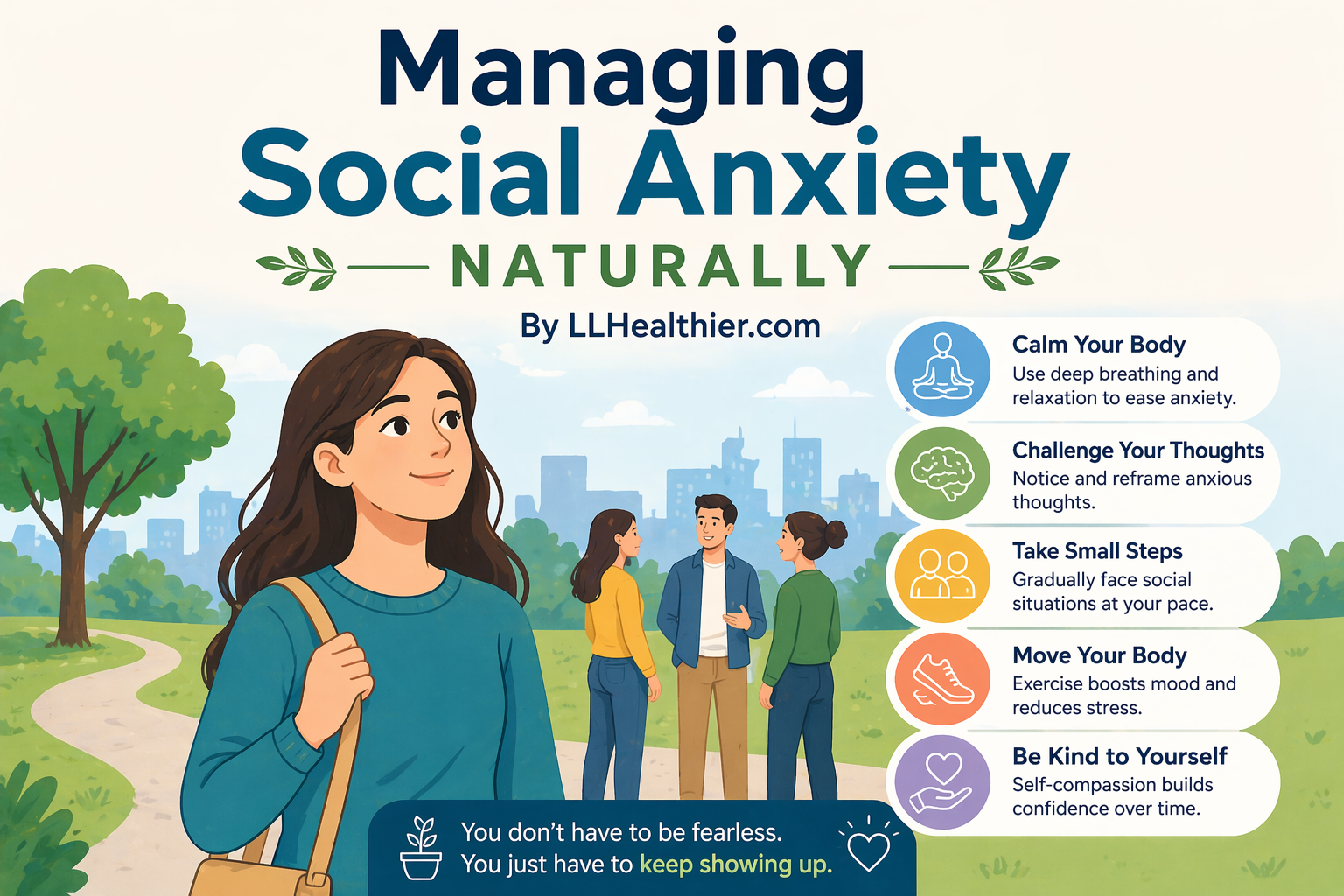
Managing Social Anxiety Naturally
Social anxiety can make ordinary life feel far more difficult than it appears from the outside. A casual conversation, work meeting, party, first date, classroom discussion, or even ordering food can create a level of stress that others may not fully understand. While some people assume social anxiety is simply shyness, it is usually more intense than that.
For many people, social anxiety involves a persistent fear of being judged, embarrassed, rejected, or negatively evaluated by others. The mind may race before an event, the body may tense during it, and afterward there may be hours of replaying every word or facial expression.
This can be exhausting.
The good news is that social anxiety is manageable, and many people improve greatly over time. Natural approaches can be especially helpful when used consistently. These methods focus on calming the nervous system, changing thought patterns, building confidence through practice, and strengthening daily habits that support emotional balance.
Managing social anxiety naturally does not mean forcing yourself to become the loudest person in the room. It means learning to feel safer, steadier, and more free in social situations.
Understanding What Social Anxiety Really Is
Social anxiety is not a character flaw. It is not weakness, laziness, or a lack of personality. It is a pattern involving the brain, body, emotions, and learned expectations.
When someone with social anxiety enters a social setting, the nervous system may react as if danger is present. Heart rate rises. Muscles tense. Sweating may increase. Thoughts become self-focused. Attention narrows toward possible mistakes or signs of rejection.
The person may think:
What if I say something stupid?
What if they think I am awkward?
What if I look nervous?
What if I embarrass myself?
These thoughts feel urgent, even when the actual situation is safe.
Understanding this matters because many people blame themselves for symptoms that are better understood as stress responses.
Why Social Anxiety Often Grows
Social anxiety can develop for many reasons.
Some people have naturally sensitive nervous systems. Others had critical family environments, bullying experiences, rejection, trauma, or years of feeling judged. Some learned to avoid discomfort early, which provided short-term relief but strengthened fear over time.
Modern life can worsen the issue.
Heavy social media use increases comparison and self-consciousness. Remote lifestyles may reduce face-to-face practice. Constant digital communication can make real-time conversation feel harder.
Whatever the cause, social anxiety is treatable because patterns can change.
Start with the Body First
Many people try to think their way out of anxiety while their body remains in a stress state.
When the nervous system is activated, logic has less influence. This is why calming the body first can be so effective.
Slow breathing is one of the best tools available.
Try inhaling gently through the nose for four seconds, then exhaling for six seconds. Continue for several rounds before entering a stressful social setting or while sitting quietly beforehand.
Longer exhales often help signal safety to the body.
Posture matters too. Shoulders back, jaw relaxed, feet grounded, and steady breathing can shift how you feel more than you may expect.
The goal is not to eliminate every symptom. It is to reduce alarm enough to function.
Reduce Stimulants That Amplify Anxiety
Many people with social anxiety unknowingly intensify symptoms through lifestyle habits.
Too much caffeine can mimic anxiety. It may cause shakiness, rapid heartbeat, sweating, and racing thoughts, especially before social events.
Poor sleep can heighten emotional reactivity and make confidence feel fragile.
Heavy alcohol use may seem helpful socially, but it often worsens anxiety later and can create dependency on drinking to cope.
A more balanced routine often includes moderate caffeine, consistent sleep, movement, hydration, and regular meals.
Sometimes anxiety improves when the body is treated more gently.
Catch the Spotlight Effect
One common thinking trap in social anxiety is believing everyone is noticing you far more than they actually are.
Psychologists often call this the spotlight effect.
You may think people are tracking your nervousness, awkward pause, voice crack, blushing, or small mistake. In reality, most people are focused on themselves. They are thinking about their own appearance, their own words, their own insecurities, or what they need to do next.
This perspective can be freeing.
You are usually not the center of scrutiny you imagine.
People are busy being human too.
Shift Attention Outward
Social anxiety often pulls attention inward. You become hyperaware of your heartbeat, hands, voice, facial expression, posture, and every sentence you say. This self-monitoring increases anxiety.
A helpful shift is outward attention. Notice the room. Listen carefully to what the other person is saying. Observe colors, sounds, details, and expressions. Ask curious questions. Focus on connection rather than self-performance.
When attention leaves the internal microscope, anxiety often softens.
You do not need to impress everyone. You need to engage with the moment.
Challenge Catastrophic Thoughts
Social anxiety often speaks in exaggerated predictions.
If I pause, they will think I am weird.
If I blush, everyone will judge me.
If I say the wrong thing, I will be humiliated.
If I feel anxious, the event is ruined.
These thoughts feel convincing but are often unrealistic.
Ask yourself:
What is the actual evidence?
How would I view someone else making the same mistake?
What is the most likely outcome, not the worst imagined one?
Could I handle mild discomfort if it happened?
Most feared outcomes are far less dramatic than the anxious mind predicts.
Practice Small Exposure Consistently
Avoidance feeds social anxiety.
Each time you avoid a phone call, gathering, introduction, question, or conversation, anxiety gets the message that avoidance was necessary for safety.
Relief feels good in the short term, but fear grows long term.
Natural progress often comes through gentle exposure. That means taking manageable steps regularly.
Say hello to a cashier. Ask a store employee a question. Make small talk with a coworker. Attend a gathering briefly. Speak once in a meeting. Join a class. Call instead of texting sometimes.
Small exposures repeated consistently often change confidence more than dramatic one-time pushes.
Stop Replaying Every Interaction
Many people with social anxiety suffer twice. First during the interaction, then afterward through rumination.
They replay what they said, analyze facial expressions, assume others judged them, and search for mistakes.
This habit strengthens anxiety because the brain learns social situations are major threats requiring hours of review.
After interactions, practice closing the mental file.
Tell yourself, “The conversation is over. I do not need to autopsy it.”
Then redirect attention to the present task.
No conversation requires forensic investigation.
Build Social Skills Without Shame
Sometimes anxiety and skill gaps coexist. That is okay.
A person who has avoided social settings for years may feel rusty. This does not mean they are broken. It means they need practice.
Skills can be learned.
Good eye contact, open body language, asking follow-up questions, listening actively, smiling naturally, and sharing simple personal details all help connection.
You do not need perfect charisma.
Warmth matters more than polish.
Many socially successful people are not dazzling performers. They are simply comfortable, interested, and kind.
Use Movement to Release Tension
Anxious energy often gets trapped in the body.
Exercise can be a powerful natural support for social anxiety. Walking, strength training, cycling, yoga, swimming, and stretching all help regulate stress chemistry and improve mood.
Movement also builds self-respect and body confidence. Even a brisk walk before a social event can reduce tension and create steadier energy.
The body was designed to move stress through, not store it endlessly.
Build Confidence Through Competence
Confidence in social settings is helped by confidence in life overall.
When people feel capable in work, hobbies, fitness, learning, or daily responsibilities, they often carry themselves differently socially.
Develop skills unrelated to anxiety.
Learn something new. Improve at your job. Join a hobby group. Volunteer. Build routines. Keep promises to yourself. This creates identity beyond “the anxious person.”.You become someone with substance, not someone defined by symptoms.
Accept Some Anxiety as Normal
Many people with social anxiety believe they must feel zero anxiety before they can succeed socially. That belief keeps them trapped.
Even confident people feel nervous sometimes before presentations, dates, interviews, or unfamiliar gatherings.
The goal is not no anxiety.
The goal is functioning with manageable anxiety.
You can feel nervous and still speak.
You can blush and still connect.
You can be awkward for a moment and still be liked.
Confidence often grows when you stop demanding perfect calm.
Choose Supportive Environments
Not every room is healthy.
Some groups are cold, judgmental, cliquish, or superficial. Anyone might feel anxious there.
Seek spaces that align with your values and interests. Hobby clubs, volunteering, fitness groups, faith communities, classes, book groups, and professional circles often create easier conversation because people share a purpose.
Anxiety is often lower when connection grows around shared activity rather than forced performance.
Limit Social Media Comparison
Many people compare their real awkward moments to other people’s edited highlights.
Social media can make it seem like everyone else is attractive, witty, confident, and socially fulfilled all the time. That picture is false.
Limiting comparison-heavy content can reduce unnecessary insecurity.
Spend more time in real conversations and less time observing curated ones.
Know When to Seek Therapy
Natural strategies help many people, but some social anxiety is severe enough to deserve professional care.
If anxiety causes panic, major avoidance, career limits, isolation, depression, heavy substance use, or inability to function, therapy can be life-changing.
Cognitive behavioral therapy is especially effective for many people with social anxiety. Exposure-based work, trauma treatment, and medication support may also help when appropriate.
Seeking help is wise, not shameful.
What Progress Often Looks Like
Progress may be subtle at first.
You recover faster after awkward moments.
You speak up once instead of staying silent.
You attend events without cancelling.
You stop replaying conversations for hours.
You care less what strangers think.
You feel nervous but go anyway.
You laugh more.
These shifts are meaningful.
A Realistic Daily Plan
A practical approach might include sleeping on schedule, reducing excessive caffeine, exercising most days, practicing breathing, challenging anxious thoughts, and taking one small social risk regularly.
This sounds modest because modest habits often work.
Change usually comes from repetition, not dramatic breakthroughs.
Managing social anxiety naturally is possible for many people through consistent habits that calm the body, reshape thinking, and gently expand comfort zones.
Slow breathing, better sleep, movement, reduced avoidance, outward attention, thought challenges, and regular practice can create real change over time.
You do not need to become a different personality. You need to become less controlled by fear. The version of you beneath social anxiety is often more capable, likable, and steady than you currently realize.
Found this article interesting? Bookmark it to read again later.
Then, share it for others to read. 🌎
Thank you!




Post Comment